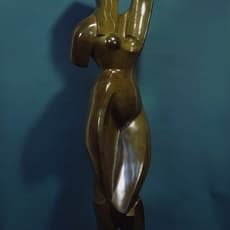
Born in 1887 in Kiev, Ukraine, Archipenko attended the Kiev Art School. He began to sculpt in 1904 and as a student was awarded his first commission from a wealthy Polish patron.
Quick Facts
- Based in
- Nice, France
- Country
- Ukraine
- Born
- –
- Type
- Individual
Represented By
About Alexander Archipenko
Born in 1887 in Kiev, Ukraine, Archipenko attended the Kiev Art School. He began to sculpt in 1904 and as a student was awarded his first commission from a wealthy Polish patron.
Born in 1887 in Kiev, Ukraine, Archipenko attended the Kiev Art School. He began to sculpt in 1904 and as a student was awarded his first commission from a wealthy Polish patron. Although young, innovative, rebellious, and against academic tradition, Archipenko was also deeply influenced in Byzantine painting, frescoes, and mosaics. After being expelled from art school in Kiev, he lived for a short time in Moscow, where he associated with a group of avant-garde artists, before leaving Russia for Paris in 1908. Shortly after his arrival in Paris, he met Fernand Léger and became absorbed into the heart of the European avant-garde circle, which included Apollinaire, Delaunay, Gleizes, Metzinger, Picabia, Marcel Duchamp, and Raymond Duchamp-Villon among others. Archipenko had his first exhibition at the 1910 Salon des Indépendants, the historic first showing in Cubism, in which his sculpture appeared along with Duchamp-Villon’s. In the following years he exhibited frequently both in Paris and abroad. In 1912 he had his first solo exhibition in Hagen, Germany at the Museum Folkwang and in 1913 exhibited at the Armory Show in New York. In 1914, at the Salon des Indépendants, he exhibited Medrano II, his renowned sculpture exhibiting the influence of the Futurism, especially Boccioni’s rendering of the figure as combination of dynamically moving geometric planes in his famous sculpture The Unique forms of Continuity is Space, 1912 (Museum of Modern Art, New York). Archipenko’s 1914 exhibition received a glowing review from Apollinaire, who praised the artist’s experimental use of “different materials—glass, zinc, wood—all polychromed. It represents a very great effort to go beyond the conventional in sculpture” (1) In addition, Archipenko’s works were frequently reproduced in avant-garde journals including Der Strum and the Futurist journal Lacerba. The artist’s interpenetration of form and space articulated in Medrano II and other works of this period would be significant to the development of modern sculpture, influencing constructivist Naum Gabo, Jacques Lipchitz, Henry Moore and others. During World War I, Archipenko lived outside of Nice, where he focused on what he termed “sculpto-painting,” colorful and relatively low relief sculpture supported on panel. As the artist described it: “a panel uniting colors and forms…interdependencies of relief, concave or perforated forms colors and textures…made of papier-mâché, glass, wood or metal…(2) He continued to work on the sculpto-paintings in the early twenties after his return to Paris, where he threw himself back into the development of his career with vigor. From 1919-1923 he exhibited throughout Europe including Geneva, London, Zurich, Brussels, and Athens. In 1921, at the invitation of Katherine Drier and Marcel Duchamp, thirty-three of his works were presented at the Société Anonyme in New York. The exhibition, which Duchamp publicized with an ironic Dada poster introducing Archie Pen Co with an image of one of the artist’s nude torso sculptures transformed into a futurist ball-point pen, attracted considerable attention among the New York avant-garde. In 1923 Archipenko moved to New York and for the remainder of his career he taught and worked in the U.S., becoming a citizen in 1928. He established a number of art schools in various locations including New York City, Woodstock, Los Angeles and Chicago and taught at the New Bauhaus and at many other colleges and art schools throughout the country. In his own work, his style shifted in the later years to include more naturalistic representations of the figure and classical themes, although he never departed from abstraction. In 1960 Archipenko published a survey of his oeuvreArchipenko: Fifty Creative Years 1908-1958. He died four years later on February 25 in New York. 1) Katherine Jánszky Michaelsen and Nehama Guralnik, Alexander Archipenko: A Centennial Tribute (Washington D.C.: National Gallery of Art and Tel Aviv Museum), 29. 2) Ibid, 39.
Art Fair Career Timeline
Works in Museum Collections
Collection data via The Metropolitan Museum of Art, Harvard Art Museums (CC BY), and Europeana
Related Artists
Discover more artists →
Frequently Asked Questions
What medium does Alexander Archipenko work in?
Alexander Archipenko primarily works in Sculpture, Painting.
Where is Alexander Archipenko based?
Alexander Archipenko is based in Nice, France.
When was Alexander Archipenko born?
Alexander Archipenko was born in 1887 and died in 1964.
What is Alexander Archipenko's nationality?
Alexander Archipenko is from Ukraine.