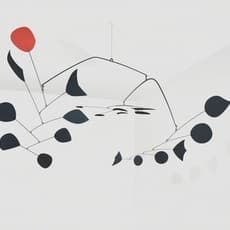
Credited with the invention of the mobile, Alexander Calder revolutionized twentieth-century art with his innovative use of subtle air currents to animate sculpture. An accomplished painter of gouaches and sculptor in a variety of media, Calder is best known for poetic arrangements of boldly colored, irregularly shaped geometric forms that convey a sense of harmony and balance.
Quick Facts
- Based in
- New York, NY and Roxbury, CT, USA
- Country
- United States
- Born
- –
- Type
- Individual
Represented By
About Alexander Calder
Credited with the invention of the mobile, Alexander Calder revolutionized twentieth-century art with his innovative use of subtle air currents to animate sculpture. An accomplished painter of gouaches and sculptor in a variety of media, Calder is best known for poetic arrangements of boldly colored, irregularly shaped geometric forms that convey a sense of harmony and balance.
Credited with the invention of the mobile, Alexander Calder revolutionized twentieth-century art with his innovative use of subtle air currents to animate sculpture. An accomplished painter of gouaches and sculptor in a variety of media, Calder is best known for poetic arrangements of boldly colored, irregularly shaped geometric forms that convey a sense of harmony and balance. Calder was born in a suburb of Philadelphia to a family of artists. His grandfather, Alexander Milne Calder, and father, Alexander Stirling Calder, created sculptures and public monuments, and his mother was a painter. Accustomed to traveling in pursuit of public art commissions, the family moved to Pasadena, California, in 1906. The new environment—with its expansive night sky studded with brilliant planets and stars—fascinated the young Calder. These cosmic forms strongly influenced the structure and iconography of his future work. At a young age, Calder began using tools and found materials to create various structures and inventions. This constructive impulse led him to attend the Stevens Institute of Technology, where he received a degree in mechanical engineering in 1919. Yet by 1922 he had abandoned his new career. After a stint as a seaman, Calder began formal art study at the Art Students League in New York in 1923. During this period, Calder worked as a freelance illustrator and often visited zoos and circuses to sketch. Calder moved to Paris in 1926, and during his seven-year stay he delighted fellow artists including Man Ray, Joan Miró, Fernand Léger, Le Corbusier and Piet Mondrian and attracted the attention of art patrons with his whimsical wire figures and portrait heads. Most notably, he created small sculptures of circus animals and performers with movable parts and developed and toured a performance/demonstration dubbed the “Cirque Calder.” This series culminated in the completion of his most celebrated piece, Circus (1932, Whitney Museum of American Art). Calder’s use of irregular, biomorphic forms that recall the work of Miró reflected the influence of Surrealism and Dada, but it was the art and concepts of Mondrian that would have the most decisive impact on Calder’s work. Calder visited Mondrian’s studio in 1930 and later described how the experience transformed his understanding of abstract art. He wrote, “This one visit gave me a shock that started things. Though I had often heard the word ‘modern’ before, I did not consciously know or feel the term ‘abstract.’ So now at thirty-two, I wanted to paint and work in the abstract.” (1) Shortly thereafter, Calder was invited to join the international Abstraction-Création group that included Mondrian, Theo van Doesburg, Robert and Sonia Delaunay, Jean Arp, and many other artists working with geometric abstract forms. Calder was impressed by Mondrian’s reduction of visual imagery to a vocabulary of flat planes of primary colors. He suggested that Mondrian consider adding movement to the forms. Mondrian rejected the idea, stating “my painting is already very fast.” (2) Calder soon took his own advice and began experimenting with movement in his work. At first, he drew on his mechanical training to devise cranks and motors that would produce kinetic effects. The following year, Calder exhibited these new pieces, christened “mobiles” by Marcel Duchamp, as well as non-moving wire abstractions termed “stabiles” by Jean Arp. By 1932 Calder realized that ambient air currents were strong enough to move lightweight sculptures, and he abandoned prescribed patterns of movement for more spontaneous rhythms. In 1933, Calder reestablished his home base in the United States, on a farm in Roxbury, Connecticut. The years from this point to the late 1950s were the most varied and prolific of Calder’s career. As he emerged as an artist of international stature, with a mid-career retrospective at the Museum of Modern Art in 1943, Calder continued to make mobiles (hanging and standing) and stabiles made out of sheet metal, as well as paintings, jewelry, and set designs for performances by Martha Graham, Eric Satie, and others. When scrap metal was in short supply during World War II, Calder turned to wood. In 1953, the Calder family purchased a home in Saché, France, and they began dividing their time between Connecticut, France and periods of extended travel. By the end of the 1950s, the proportions of Calder’s mobiles had dramatically increased and he was completing more site-specific commissions. Large-scale sheet-metal stabiles commissioned for public spaces dominate Calder’s late career in the 1960s and 1970s. Their vivid colors, sweeping arches and shapes evoking birds and animals offer a counterpoint to rectilinear modern architecture and breathe life into urban environments around the world. One notable example is Flamingo(1973, Federal Center Plaza, Chicago). Widely celebrated during his lifetime, Calder died just a few weeks after the opening of “Calder’s Universe,” a retrospective at the Whitney Museum of American Art. 1. Alexander Calder, An Autobiography in Pictures (New York: Pantheon Books, 1966), p. 113. 2. Ibid. References: Arnason, H. H. Calder. Princeton, NJ: Van Nostrand, 1966. Calder, Alexander. An Autobiography in Pictures. New York: Pantheon Books, 1966. Giménez, Carmen, and Alexander S. C. Rower, ed. Calder: Gravity and Grace. London: Phaidon Press, 2004. Lipman, Jean. Calder’s Universe. New York: Whitney Museum of American Art, 1976. Marter, Joan M. Alexander Calder. Cambridge: Cambridge University Press, 1991. Prather, Marla. Alexander Calder 1898–1976. Washington D.C.: National Gallery of Art, 1998.
Art Fair Career Timeline
Related Artists
Discover more artists →
Frequently Asked Questions
What medium does Alexander Calder work in?
Alexander Calder primarily works in Sculpture, Installation.
Where is Alexander Calder based?
Alexander Calder is based in New York, NY and Roxbury, CT, USA.
When was Alexander Calder born?
Alexander Calder was born in 1898 and died in 1976.
What is Alexander Calder's nationality?
Alexander Calder is from United States.
What exhibitions has Alexander Calder participated in?
Alexander Calder has participated in 1 exhibition, including Documenta 1959.