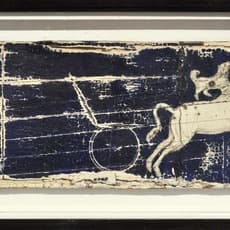
Known for his inventive box constructions, experimental films, and collages, Joseph Cornell occupies a singular place in the history of twentieth-century American art. Comprising found objects culled from souvenir shops, penny arcades, dime stores, and discarded materials, Cornell’s works bring incongruous items together in richly allusive assemblages that deny fixed narratives or a single meaning.
Quick Facts
- Based in
- New York, NY, USA
- Country
- United States
- Born
- –
- Type
- Individual
Represented By
About Joseph Cornell
Known for his inventive box constructions, experimental films, and collages, Joseph Cornell occupies a singular place in the history of twentieth-century American art. Comprising found objects culled from souvenir shops, penny arcades, dime stores, and discarded materials, Cornell’s works bring incongruous items together in richly allusive assemblages that deny fixed narratives or a single meaning.
Known for his inventive box constructions, experimental films, and collages, Joseph Cornell occupies a singular place in the history of twentieth-century American art. Comprising found objects culled from souvenir shops, penny arcades, dime stores, and discarded materials, Cornell’s works bring incongruous items together in richly allusive assemblages that deny fixed narratives or a single meaning. Describing his process, Cornell once stated “Everything can be used, but of course one doesn’t know it at the time. How does one know what a certain object will tell another?” Objects including seashells, marbles, toys, and illustrations reference Cornell’s many personal obsessions ranging from childhood pursuits and memories to his adult passion for astronomy, ballet, film, and nineteenth-century French literature. As a result of his dreamlike scenarios and poetic juxtapositions, Cornell was often associated with the French Surrealists. He exhibited at the Julien Levy Gallery in New York, a gallery that was instrumental in introducing American audiences to Surrealism. The connection between Cornell and Surrealism was reinforced by his inclusion in the celebrated 1936 exhibition “Fantastic Art, Dada, and Surrealism” held at the Museum of Modern Art. Much later, in 1972, he would be included in the “Dada, Surrealism and Their Heritage” exhibition at the Museum of Modern Art. Yet Cornell’s relationship to the Surrealists was more complicated than these points of connection imply. While he admired many of the works made by the Surrealists and was friendly with artists associated with the group—particularly Marcel Duchamp—he objected to being labeled a member of the group. A central difference between Cornell and the Surrealists was Cornell’s disinterest in dream theories or in exploring the subconscious—the foundation of Surrealism. Cornell instead preferred to use his work to concentrate on what he termed “healthier possibilities.” Cornell began exploring collage around 1931 after viewing Max Ernst’s collage-novel entitled La Femme 100 têtes of 1929. By the mid-1930s, Cornell started creating his signature shadow box constructions, which he described as “poetic theatres or settings wherein are metamorphosed the elements of a childhood pastime.” The shadow boxes continued to be his primary focus through the 1940s. During this period, he also created collages intended for publication in the avant-garde journal View. He returned almost exclusively to collage in the mid-1950s and would continue to work in this medium until his death in 1972. In his collages of the 1960s, Cornell resurrected many of his earlier themes such as birds, objects from penny arcades, and actresses, who ranged from movie stars to local unknowns whom he had met and befriended. Beginning in the 1930s, Cornell’s works were consistently well received by those in the artistic and literary communities. During the 1960s a new generation of artists, writers, and thinkers, including Andy Warhol, John Ashbery, James Rosenquist, and Susan Sontag (immortalized in Cornell’s collage The Ellipsian c. 1966), embraced his work. Cornell was included in the 1961 exhibition “The Art of Assemblage” at the Museum of Modern Art, where he had an entire room devoted to his art. In 1967, the Solomon R. Guggenheim mounted an exhibition of his works, as did the Museum of Modern Art in 1980.
Art Fair Career Timeline
Works in Museum Collections

Hôtel du Nord
Europeana

Untitled (after René Magritte's "Time Transfixed", 1938)
1965
Europeana

The Sixth Dawn
1964
Europeana

Untitled
Europeana

Untitled
Europeana
Collection data via The Metropolitan Museum of Art, Harvard Art Museums (CC BY), and Europeana
Related Artists
Discover more artists →
Frequently Asked Questions
What medium does Joseph Cornell work in?
Joseph Cornell primarily works in Sculpture, Mixed Media, Video.
Where is Joseph Cornell based?
Joseph Cornell is based in New York, NY, USA.
When was Joseph Cornell born?
Joseph Cornell was born in 1903 and died in 1972.
What is Joseph Cornell's nationality?
Joseph Cornell is from United States.